Analysis of Halloween

Halloween is an American horror thriller movie directed by
John Carpenter in 1978. The film is set in Haddonfield, New Jersey and centres
around psychopathic killer and mental hospital escapee Michael Myers, murderer
of his older sister when he was 6 years old, returning home 15 years later to
kill.
The film opens with Michael Myers as a child killing his
sister, which is followed by a shot where Michael’s parents take his mask off
in the street and the camera cranes upwards until it fades, and then we come
back in 15 years have gone. We don’t question it we just accept it, Bordwell
and Thompson’s theory of narrative expands on Todorov’s classical Hollywood narrative
and talks about time and space, however when we rejoin the story 15 years later
from then on it tends to follow the classical Hollywood narrative.
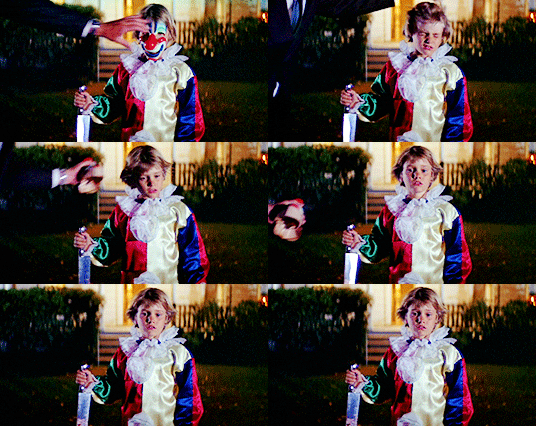 |
| Michael stabbing his sister disrupts normality at the start of the film |
There is relative equilibrium at the beginning from where the
film picks up from. The scene after Myers kills his sister is followed by a
shot of a doctor and nurse driving to the hospital, nothing out of the ordinary
is happening and there is no reason to suspect any unsettlement or disruption.
The event and recognition go hand in hand, the event is Michael Myers escaping
on the night before Halloween 15 years after murdering his sister, the
recognition is Dr. Loomis realising Michael has escaped and happens straight
after the event. Myers has escaped the night before Halloween on purpose so
that he gets back into town on Halloween night, the doctor knows this; it isn’t
an accident. This results in the resolution being followed from the doctor’s
perspective. Dr. Loomis returns to the old abandoned Myers family house waiting
for Michael to come back, conventional of horror movies, there is no real
resolution, the doctor shoots Michael 6 times, once in the head and another 5
times in the chest and he falls off the second floor patio, we assume Michael
is dead but in the final shot of the film his body is nowhere to be found, and
the film fades out with heavy breathing, reinforcing that he is in fact still
alive, giving the film no closure and leaving it open to sequels.
 |
| Shot of Michael after Dr. Loomis shoots him |
 |
| Next outside shot Michael's body is gone and the soundtrack restarts |
When you look at character types in relation to Propp’s
theory in relation to characters that keep reappearing in narratives, there are
at least four in Halloween. Michael Myers is the villain of the film and this
is obvious, we know this from the start of the movie, he kills his sister and
escapes from a mental hospital. There Is no real hero in Halloween, however, in
a way the doctor is the hero of the film; he is not the archetypal good looking
hero but he is the protagonist who goes after Michael when he returns to the
town. The victim of the film is Lauri as she spends the majority of the film
being followed by Michael, who is trying to kill her all the while although
there are other female victims such as Annie who Michael actually kills. The
police officer is the helper, he listens to and helps the doctor when he is
waiting outside of the Myers house. The film also uses Carol Clover’s final
girl theory. The main character Laurie is middle class, well educated, doesn’t
go out, doesn’t have sex and doesn’t drink or do drugs (other than smoking the
joint in the car with Annie), all typical traits of the final girl.
 |
| Laurie defending herself against Michael There are many examples of binary opposition throughout the film, conventional of most horror films good vs. evil is the most obvious one in Halloween, with Laurie being the good hero and Michael being the bad villain. Another is past and present, the film begins with Michael killing his sister and then shifts back to present day, 15 years on. Purity and promiscuity; Laurie is the “square” of her friends, whilst her friends are interested in boys and parties, she is more interested in her studies and thinks that boys are intimidated by her intelligence. Natural and supernatural; Michael survives getting shot 6 times and falling off a balcony, suggesting there is something supernatural, potentially even non-human about him. As well as being contrasted with Laurie in terms of good and evil, Michael is also contrasted with Dr. Loomis and the sheriff, they are the authority and he is the danger that they are trying to stop. |
 |
| Dr. Loomis spends the film trying to stop Myers |
Halloween both complies with and challenges narrative
theories. The film doesn’t follow the Classical Hollywood Narrative, but not
many horrors do. However, the character has clear character types, binary
oppositions and follows the final girl theory.

No comments:
Post a Comment