Analysis of The Crazies (2010)

The Crazies is an American thriller horror movie directed by Breck Eisner in 2010, and is a remake of the original classic horror of the same name (released in 1973) by renowned horror filmmaker George A. Romero, most notably known for his series of zombie films such as independent film Night of the Living Dead (1968). The Crazies is a film that follows the residents of a small town in Iowa suddenly plagued by insanity and then death after a mysterious toxin contaminates their water supply.
 |
| The opening scene of the movie |
Bulgarian structural linguist Tzvetan Todorov believed that all stories followed the same structure, which he broke down into 5 stages, the “Classical Hollywood Narrative”. The first stage is equilibrium, the diegesis is set out, everything is normal and usually the beginning is a calm period, status quo. Then an event occurs; agents of disruption cause disequilibrium to the narrative, followed by recognition of the event and an attempt to establish new stability with obstacles placed in the way of the quest. The fourth stage is resolution, the quest has been achieved and results in the final stage, usually a happy ending and either returns to the original diegesis or forms a new one, this is called the new equilibrium
The Crazies does not follow the Classical Hollywood Narrative. The film starts with a scene of a burning town, introducing a state of chaos to the film from the off, this leaves the audience wanted to know what caused the event immediately. This goes against Todorov’s theory because it states a balance is present in the beginning, in The Crazies this is not the case. Straight after the opening scene the film continues to superimpose the text “two days later” meaning that the majority of the film has taken place and the story is being told. Although we do not see the event happen we know it has happened because we are told about the plane crash. The plane crash itself turns out to be an accident is found out to be what was carrying the virus, which had been developed by the government, and was on its way to being destroyed because it possessed too big of a threat. The first known person to be infected with the virus is Rory Hammil who approaches the sheriff with a shotgun; to begin with alcohol is to blame for Rory’s behaviour but later in the film it is pointed out that his alcohol level was 0.0.
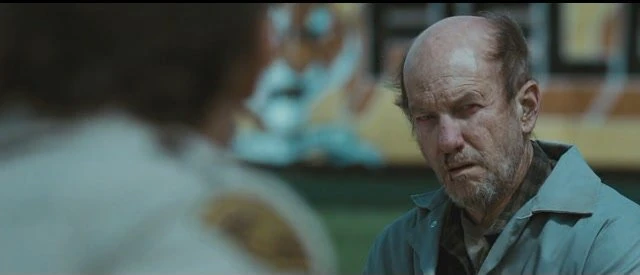 |
| Rory Hammill
The virus continues to spread and the chaos with it, the balance between normality and chaos shifts immediately. There is no full resolution or new equilibrium in the film. A containment protocol that destroyed Ogden Marsh commences on the town that the two main characters (a couple) approach. This is conventional of horror films but also means Todorov’s theory does not apply. After the credits a news report plays showing that it is far from over:
|
After the credits
There are many instances of binary opposition in The Crazies. Binary opposition are sets of opposite values which reveal the structure of media texts (e.g. GOOD and EVIL), this theory was first coined by French anthropologist Claude Levis Strauss. One instance is sanity and insanity, the same characters (the survivors) try to survive and fend off the infected insane characters. Healthy and unhealthy is another case of binary opposition in the film.
 |
Healthy vs unhealthy |
The health of normal people deteriorates as they cannot eat properly and the insane infected people are obviously unhealthy. Day and night also applies, night implies danger as there is limited sight and shadows and day can be equally as dangerous but with better vision and confidence in the characters, light and dark is the same concept. Alive and dead applies too, People are killed by the insane and people who are not infected are alive, David is the male and Judi is the female. They are in a relationship and Judi is pregnant. The male has more power and the female is targeted more.
 |
| We see Judy's true character when she fights back; in this case, hiding in the truck and shooting a Crazy. |
 |
| The masks give the military no identity, dehumanising them. It could also be said that they reflect the fear of government control and its power |
 |
| Russell (left) acts as the Deputy to David (right) as the Sheriff, but also wants to help them all escape from Ogden Marsh. |
Russian critic Vladimir Propp further broke down the Classical Hollywood Narrative, he figured out characters that kept reappearing in stories: the protagonist (hero), the antagonist (villain), helper, dispatcher, false hero among others. In The Crazies the villain is the US army, they crashed a military aircraft containing a dangerous chemical into the town’s water, they are the reason the virus is in the community. Main character David (the town Sheriff) is the hero, he saves his, wife and several other people and escape from the quarantine, and survives. Rory counts as the dispatcher because he is the first townsperson to become infected by the virus, and the mayor is the false hero as he refuses to turn off the water for the town and by doing so he allows the virus to spread through the rest of the town, although he was thinking of the town’s wellbeing as he knew that they would need crops. Carol Clover’s final girl theory applies as Judi survives. Although The Crazies doesn’t use final girl theory in the sense that characters that have sex, drink alcohol and do drugs die, Judi doesn’t have sex, drink alcohol or do drugs and ultimately survives.
The Crazies both supports and challenges theories in relation to character and narratives. The Crazies challenges the Classical Hollywood Narrative in the sense that there is no equilibrium from the off and no requilibrium at the end of the film, however it does support character types, binary opposition and final girl theory. It is typical that horror films start with a disrupted equilibrium and end with a not so happy equilibrium leaving room for potential sequels, in this case the containment protocol in the town that David and Judi are approaching gives the impression that more chaos is going to happen and leaves the film open to a sequel or sequels.

No comments:
Post a Comment